
Conflict is a normal and unavoidable part of every relationship.
It doesn’t mean something is wrong with your partnership. It means two humans — with different histories, nervous systems, needs, and communication styles — are trying to stay connected while navigating life together. In Conflict Resolution in Relationships: How to Use Nonviolent Communication to Strengthen Connection we learn that the problem isn’t conflict itself. The problem is how most of us were taught to handle it.
Many people grow up learning that conflict means:
- Someone has to be right
- Someone has to lose
- Feelings should be suppressed
- Needs are “too much”
- Silence is safer than honesty
Over time, this leads to resentment, emotional distance, shutdown, or explosive arguments.
One of the most effective frameworks I use with clients to transform conflict into connection is Nonviolent Communication (NVC). It offers a simple, respectful structure for expressing yourself clearly while also listening with empathy.
Why Communication Breaks Down in Relationships
Most relationship conflict isn’t actually about the surface issue.
It’s about:
- Feeling unheard
- Feeling unimportant
- Feeling unsafe
- Feeling disconnected
- Feeling taken for granted
Arguments about dishes, sex, money, time, or parenting are usually about deeper emotional needs like:
- Security
- Respect
- Affection
- Autonomy
- Appreciation
- Reliability
When those needs go unmet, the nervous system goes into threat mode — and communication becomes reactive instead of relational.
This is where NVC is so powerful.
The Four Steps of Nonviolent Communication
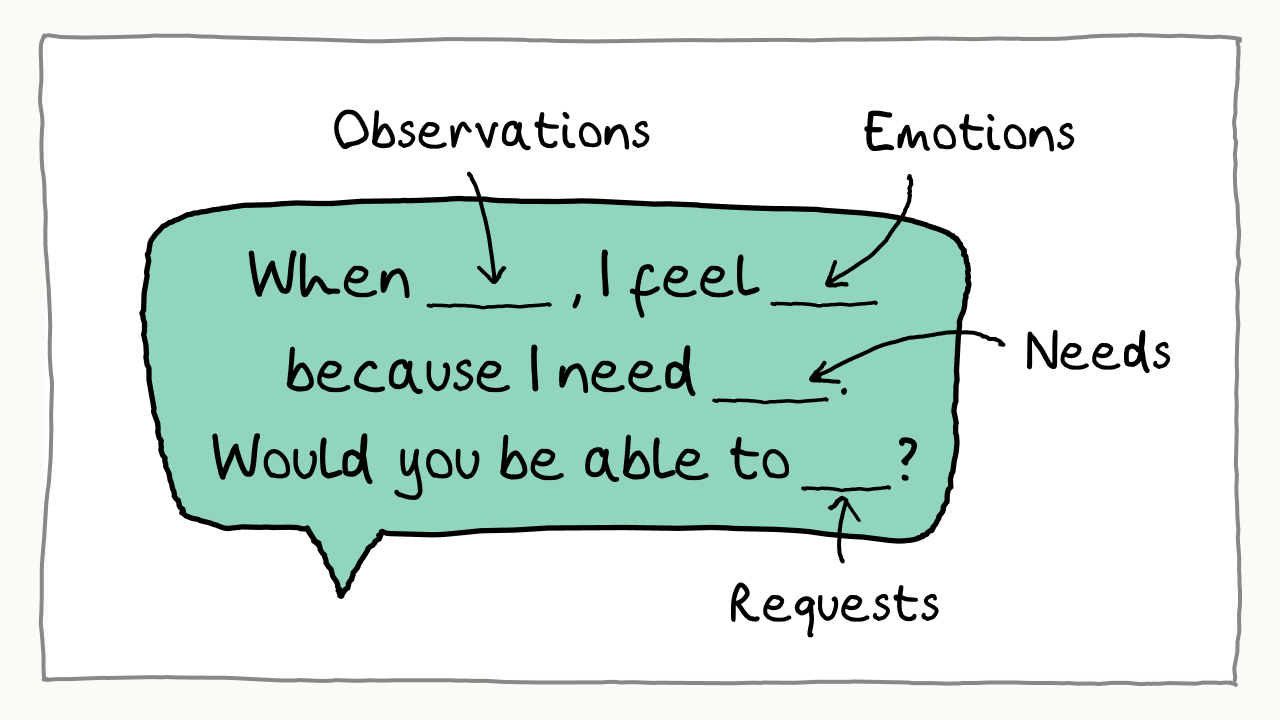
NVC helps you speak honestly without blaming, and listen without becoming defensive.
The four steps are:
- Observation – What actually happened (without judgement)
- Feeling – What you felt
- Need – What need was underneath the feeling
- Request – A clear, doable request
This structure keeps the focus on connection rather than control.
Example: Navigating Disconnection
Instead of: “You never make time for me anymore.”
Try:
Observation:
“Over the past two weeks I’ve noticed we haven’t spent much quality time together.”
Feeling:
“I’m feeling lonely and disconnected.”
Need:
“I really need closeness and shared time with you.”
Request:
“Could we plan a regular date night and protect that time together?”

Example: Navigating Feeling Unappreciated
Instead of: “You don’t care about everything I do for this family.”
Try:
Observation:
“I’ve noticed that I’ve done a lot of cooking and school runs this month.”
Feeling:
“I’m feeling exhausted and unappreciated.”
Need:
“I need support and acknowledgement.”
Request:
“Could we talk about sharing these tasks more evenly?”
Why NVC Works So Well in Relationships
Healthy relationships require:
- Emotional safety
- Mutual respect
- Accountability
- Repair skills
- Ongoing negotiation
NVC supports all of these by:
- Reducing defensiveness
- Making needs visible
- Encouraging responsibility for feelings
- Supporting empathy and understanding
- Turning conflict into collaboration
It shifts the dynamic from: “You’re the problem.”
To:
“We have a problem — how can we solve it together?”
Practical Tips for Using NVC in Relationship Conflict
- Choose the right moment. Don’t start important conversations when either of you is overwhelmed or dysregulated.
- Regulate first. Take a pause if emotions are high and return when you feel calmer.
- Be specific. Avoid “always” and “never.”
- Listen for needs. Even clumsy words are usually pointing to an unmet need.
- Make requests, not demands. Your partner always gets a choice — that’s how trust is built.
Final Thoughts
Strong relationships aren’t built by avoiding hard conversations. They’re built by learning how to have them well.
When conflict is handled with care, it can:
- Deepen intimacy
- Strengthen trust
- Increase emotional safety
- Improve connection
- Build long-term resilience
Nonviolent Communication gives you a roadmap for navigating relationship challenges with honesty, compassion, and respect — for both yourself and your partner.
And if communication feels hard right now, that doesn’t mean your relationship is failing. It just means you haven’t been given the tools yet.
- If you’d like to learn more you can attend a free taster course in NVC online.
- Or get yourself a set of NVC Feelings and Needs cards to help you get communicating.
- Or book at free 15 minute counselling session to see if you’d like to have a session with me to learn how to better communicate in your relationship